Description
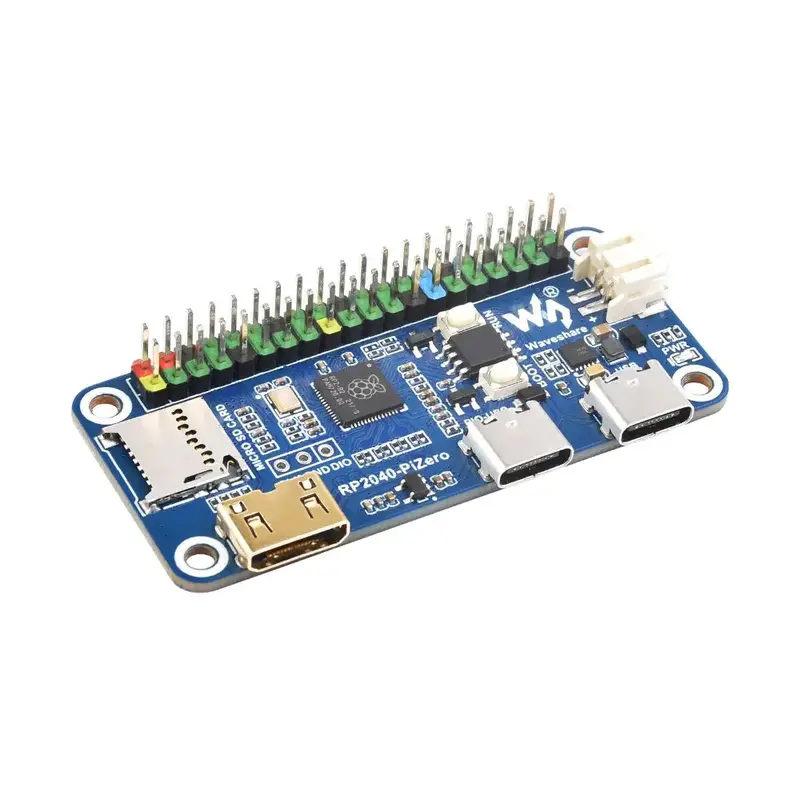
- Waveshare RP2040-PiZero Dev Board, Based RP2040, 264KB SRAM & 16MB Onboard Flash Memory
- Features dual-core ARM Cortex M0+ processor
- Integrates DVI, PIO-USB, and TF card interfaces
- Supports C++, MicroPython, and Arduino programming
- Offers comprehensive SDK and tutorials for ease of use
- Compatible with some Raspberry Pi HATs
The Waveshare RP2040-PiZero Dev Board, Based RP2040, 264KB SRAM & 16MB Onboard Flash Memory is a high-performance microcontroller board featuring a dual-core ARM Cortex M0+ processor. It offers a flexible clock speed up to 133 MHz, 264KB of SRAM, and 16MB of onboard flash memory.
This development board is equipped with a DVI interface, a PIO-USB port, and a TF card slot, enhancing its versatility for various applications. It supports multiple programming environments including C++, MicroPython, and Arduino, and provides comprehensive development resources and tutorials for ease of use.
View moreWhat’s Included
- 1x Waveshare RP2040-PiZero Dev Board, Based RP2040, 264KB SRAM & 16MB Onboard Flash Memory
Links
Website
Waveshare RP2040-PiZero Dev Board, Based RP2040, 264KB SRAM And 16MB Onboard Flash Memory – RP2040-PiZero Wiki
Specifications
- Dual-core ARM Cortex M0+ processor with a flexible clock up to 133 MHz
- 264KB SRAM and 16MB onboard Flash memory
- Onboard DVI interface compatible with most HDMI screens
- Supports USB host or slave via onboard PIO-USB port
- Onboard TF card slot for reading and writing
- Onboard Lithium battery recharge/discharge header for mobile use
- USB 1 with device and host support
- Drag-and-drop programming via USB mass storage
- Low-power sleep and dormant modes
- 2 SPI, 2 I2C, 2 UART, 4 12-bit ADC, 16 controllable PWM channels
- Accurate on-chip clock and timer
- Temperature sensor included
- Accelerated floating-point libraries on-chip
- 8 Programmable I/O (PIO) state machines for custom peripheral support
- Integrates multiple interfaces: DVI, PIO-USB, and TF card slot
- Supports C++, MicroPython, Arduino
- Comprehensive SDK, development resources, and tutorials available
- USB Type-C connector for communication and programming
- PIO-USB port for USB host or slave use
- DVI interface with Mini HDMI connector for DVI screen
- TF card slot with SPI interface communication
- W25Q128JV 16MB NOR-Flash
- RUN and reset buttons
- BOOT button for download mode
- PH2.0 header for 3.7V Lithium battery connection, supports recharging/discharging
- 40PIN GPIO Header compatible with some Raspberry Pi HATs
- Debug interface included

 Unconditional Satisfaction Guarantee