$135.86
$271.71
50% OFF! Hot items selling fast—Grab them before they're gone!
 Unconditional Satisfaction GuaranteeNo Shipping Fees Above 302 Months to Decide. Returns Simplified.
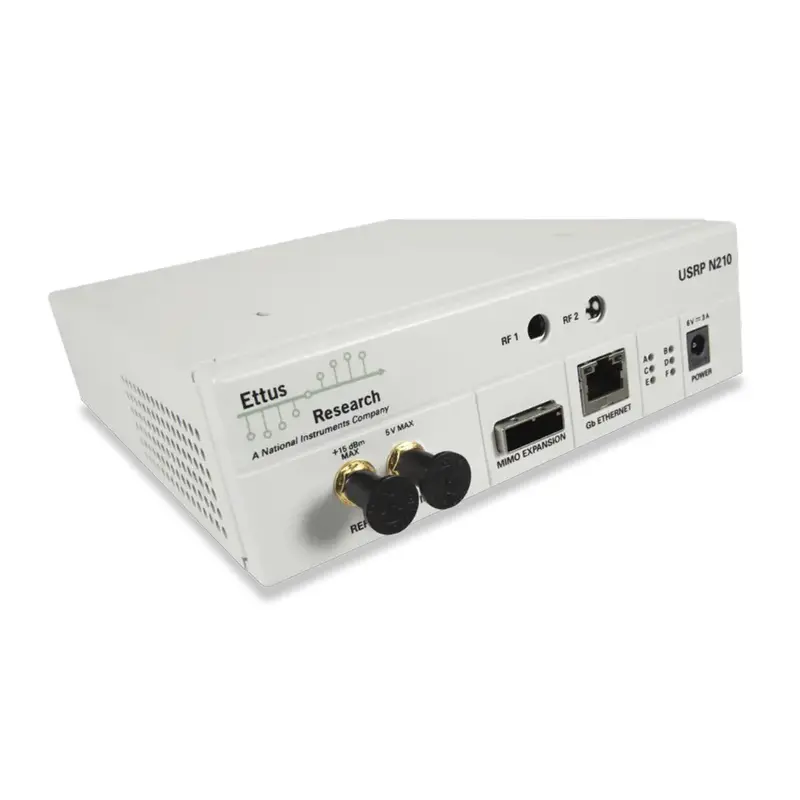
The Ettus Research USRP N210 SDR represents the pinnacle of performance within the Universal Software Radio Peripheral family, designed to facilitate the rapid development and implementation of advanced software radio systems. This hardware is particularly well-suited for applications demanding high radio frequency performance and extensive bandwidth, such as physical layer prototyping, dynamic spectrum access, cognitive radio, spectrum monitoring, and networked sensor deployment. The device features MIMO capability with substantial bandwidth and dynamic range, enabled by its Gigabit Ethernet interface, which allows for simultaneous full duplex data transmission and reception at 50 MS/s.
The USRP N210 is engineered for high-bandwidth and high-dynamic range processing, making it ideal for complex communication applications that require swift development. Its architecture incorporates a Xilinx Spartan 3A-DSP 3400 FPGA, dual ADCs and DACs, and Gigabit Ethernet connectivity, facilitating data streaming to and from host processors. The modular design supports operations from DC to 6 GHz, and an expansion port allows for synchronization of multiple devices in a MIMO configuration.
This device can stream up to 50 MS/s to and from host applications, with the capability for users to implement custom functions within the FPGA fabric or the on-board 32-bit RISC softcore. The FPGA can process up to 100 MS/s in both transmission and reception, with firmware reloadable via the Gigabit Ethernet interface. The Networked Series MIMO connection is accessible on the front panel, allowing for a complete 2×2 MIMO configuration with an optional cable. External inputs for PPS and reference signals enable the creation of larger multi-channel systems.
The USRP Hardware Driver is the official driver for all Ettus Research products, supporting Linux, Mac OSX, and Windows. It provides a C++ and Python API, facilitating efficient application development and seamless design transitions across platforms. The driver supports various development environments, including RFNoC, LabVIEW, and MATLAB/Simulink. For those who prefer graphical programming, GNU Radio offers a free, open-source framework for graphical design.
Note: Ensure proper handling and usage of the device to avoid damage or malfunction.
View moreWhat’s Included
Links
PDF File
Specifications